The problem
Electricity-price forecasting has to contend with changing conditions and sharp price movements. A forecast needs a clear horizon and an evaluation that reflects the decision it is meant to support.
My work
I built a standalone zero-shot backtest of Amazon’s Chronos-2 on public German DE-LU day-ahead prices. I prepared the hourly series, defined the rolling evaluation, added two simple baselines, and recorded the model revision and predictions. Chronos-2 is a pretrained foundation model that I applied, not a model I authored.
System decisions
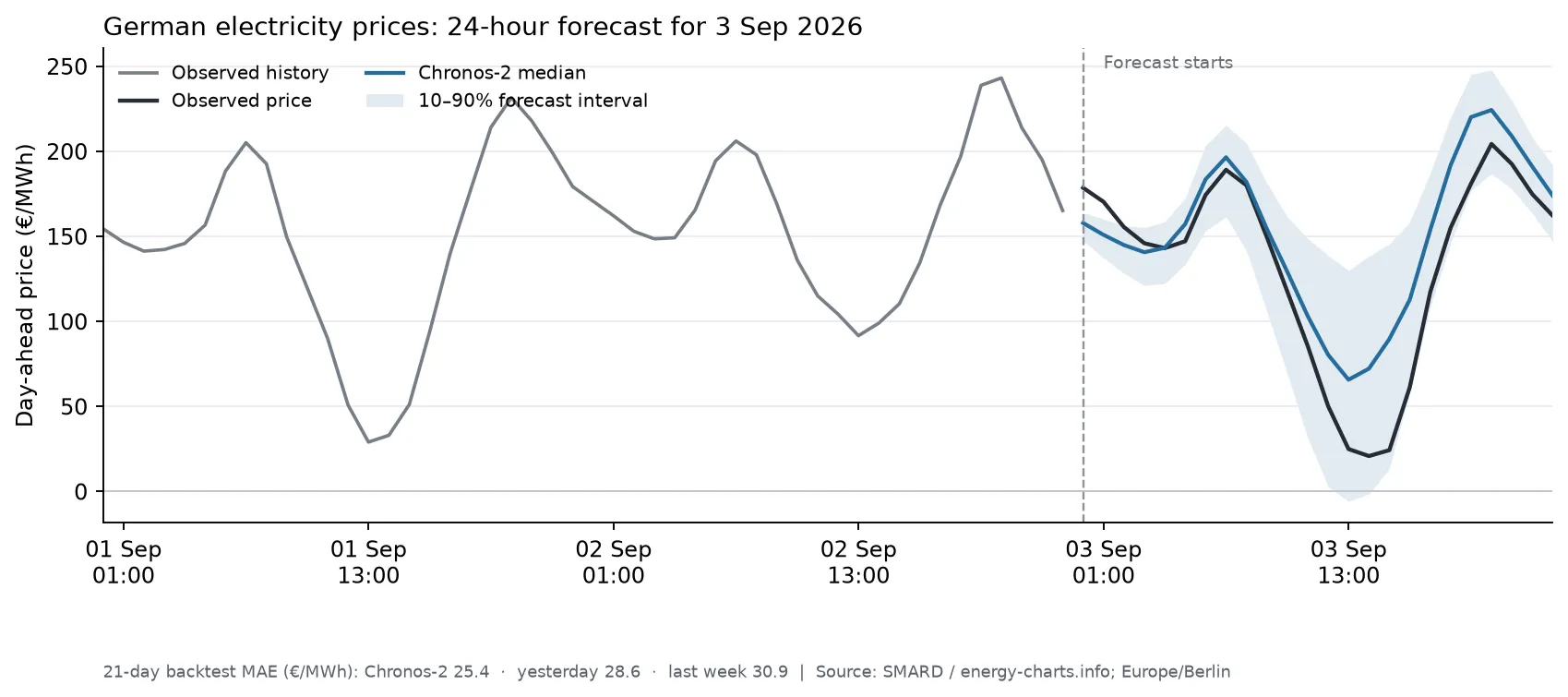
For each forecast day, the model receives the preceding 168 hourly prices and predicts the next 24 hours. Each hourly observation is the mean of four quarter-hour prices; incomplete hours and days are rejected. The model receives no future weather, calendar, plant data, or published next-day market prices.
I compared its median forecast with repeating the same hour from yesterday and from the previous week. The figure shows 3 September 2026; the evaluation below scores all 21 forecast days, from 14 August through 3 September.
Evaluation
All 504 forecast hours are included. Errors are in €/MWh; lower values are better. The values below were checked against the saved per-hour predictions.
| Forecast | MAE | RMSE |
|---|---|---|
| Chronos-2 median | 25.375 | 36.458 |
| Same hour yesterday | 28.587 | 43.377 |
| Same hour last week | 30.861 | 43.357 |
Price data: Bundesnetzagentur | SMARD.de, CC BY 4.0, retrieved via Fraunhofer ISE Energy-Charts. Quarter-hour prices were averaged to hours; the download includes the resulting observations, forecasts, and baselines. Model: Amazon Chronos-2.
Limitations
This is a past-price-only backtest over a short period, not a production scheduling forecast or evidence of general market superiority. The 10–90% model quantiles shown in the figure are not a calibrated coverage guarantee. Once actual day-ahead prices are published after the auction, those prices should be used directly. No live inference runs on this portfolio.